



IO-Link Basics

IO-Link is a standardized, fieldbus-independent communication system for point-to-point connections between sensors/actuators and the control level. As an international standard (IEC 61131-9), IO-Link enables end-to-end digital communication down to the field level and can be integrated into all fieldbuses.
Unlike traditional binary or analog interfaces, IO-Link significantly expands the functionality of sensors and actuators. In addition to process data, parameters, diagnostic information, and status data can also be transmitted bidirectionally.
Standardization ensures cross-vendor interoperability, allowing devices from different manufacturers to be seamlessly integrated into a single system.
The physical connection is made using standard unshielded cables
(typically 3-wire or 5-wire), which allows existing wiring structures to continue to be used.
Key features:
- Point-to-point connection between the IO-Link Master and device
- Cable lengths typically up to 20 m
- Standardized M12, M8, or M5 connectors
- Simultaneous power supply and data transmission over a single cable
Transmission is serial and digital, which reduces interference and signal loss compared to analog signals.
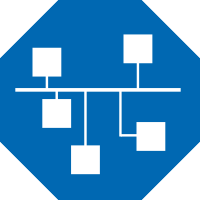
IO-Link operates using a star-shaped topology via so-called IO-Link Masters:
- The IO-Link master serves as the interface to the higher-level control system (e.g., PLC, fieldbus, or Industrial Ethernet)
- Exactly one IO-Link device is connected to each port of the Master
- Integration into existing fieldbus or Industrial Ethernet systems is achieved via the Master
This clear structure simplifies planning, installation, and maintenance and enables flexible expansion.

IO-Link supports three types of communication:
- Process data: Cyclic transmission of measured values and status information
- Service data: Parameter data for configuration and device settings
- Event data: Diagnostic and status messages
Bidirectional communication enables:
- Parameterization during operation
- Automatic device detection and replacement
- Advanced diagnostic functions
This ensures end-to-end transparency all the way down to the sensor/actuator level.

Integration and parameterization are performed using IODD (IO Device Description) files:
- Describe all properties of an IO-Link device
- Enable easy integration into engineering tools
- Standardized representation of parameters, diagnostics, and functions
Configuration is typically performed using:
- Engineering tools from the controller manufacturer
- Web interfaces or software provided by the IO-Link Master
The IODD ( IODeviceDescription) significantly simplifies the commissioning, operation, and maintenance of IO-Link systems.
It provides all relevant device information in a standardized file—including identification data (e.g., manufacturer, type, serial number), parameters, process and diagnostic data, and communication properties. This enables devices to be automatically detected, efficiently configured, and faults resolved more quickly.
The IODD enables easy integration based on the “plug-and-work” principle: New devices can be integrated into existing systems with minimal effort and, if necessary, easily replaced or reconfigured.
The result: greater flexibility, improved data quality, and increased system availability.
An IODD in ZIP file format contains, among other things, a device description, optional language and image files, and a manufacturer’s declaration.

- Digital, interference-free data transmission
- Vendor-neutral integration
- Reduced wiring effort
- Advanced diagnostic capabilities
- Easy parameterization and device management
- Support for Industry 4.0 and IIoT applications
IO-Link in the Context of Industry 4.0
IO-Link delivers structured data directly from the field level, thereby providing an important foundation for data-driven applications:
- Condition Monitoring
- Predictive Maintenance
- Energy and Process Optimization
Seamless integration into higher-level systems enables end-to-end digitalization of machines and plants—a central component of modern IIoT architectures.
Areas of Application
IO-Link is used in a wide variety of industrial sectors:
- Machinery and plant engineering
- Packaging and food industry
- Automotive industry
- Intralogistics
- Process automation
Typical applications include sensor integration, condition monitoring, and flexible machine designs.
 to top
 Contact
 Request form