







Fieldbus - a success story

The rise of classic fieldbus technology began in the 1980s with proprietary serial protocols from a number of manufacturers, with the aim of reducing the installation and maintenance costs of industrial machines and systems. One of the drivers of innovation was the automotive industry, which led to a sharp rise in demand for new, manufacturer-independent standards in the 1990s. This led the leading control system manufacturers to work on new open fieldbuses.
New requirements and specific tasks from users in a wide range of sectors, such as the process industry, in terms of transmission speeds and data volumes, provided the impetus for the development of specialized fieldbuses. The control models used predominantly determine the bus system to be used.
Many fieldbuses are based on physical transmission layers such as RS232, RS485, CAN, 4-20 mA and some others.
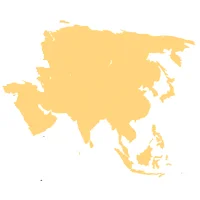
The geographical distribution of fieldbuses
is heavily dependent on the respective market on which the control system manufacturers focus.
It is important for the success of exporting machine manufacturers that their products support the leading technologies and connections of the relevant control system manufacturers in the target market.

Europe
In Europe, several well-known control system manufacturers are represented with different fieldbuses, including
- SIEMENS with PROFIBUS
- Schneider Electric with FIP and Modbus RTU
- Bosch with CAN and Sercos
- Phoenix Contact with Interbus
- ...

America
The manufacturer Rockwell Automation has positioned itself in the American market.
These fieldbuses are strongly represented:
- DF1
- DeviceNet
- ControlNet
- ...
Fieldbuses today
Due to the long service life of machines (often more than 20 years), many classic fieldbus systems can still be found in machines and systems. Due to the long product life cycles of industrial devices, the variety of products is often even greater than with Industrial EtherNet.
Components with classic fieldbus connections are often cheaper than those with Industrial EtherNet.
The mix of old/new machines in systems and the associated heterogeneity of communication protocols presents planners and technicians with challenges in terms of connectivity.
Fieldbus comparison
The available systems usually differ in terms of topology, cable lengths, transferable data volumes and speed, as well as diagnostics, cross-traffic of bus participants or other functions.
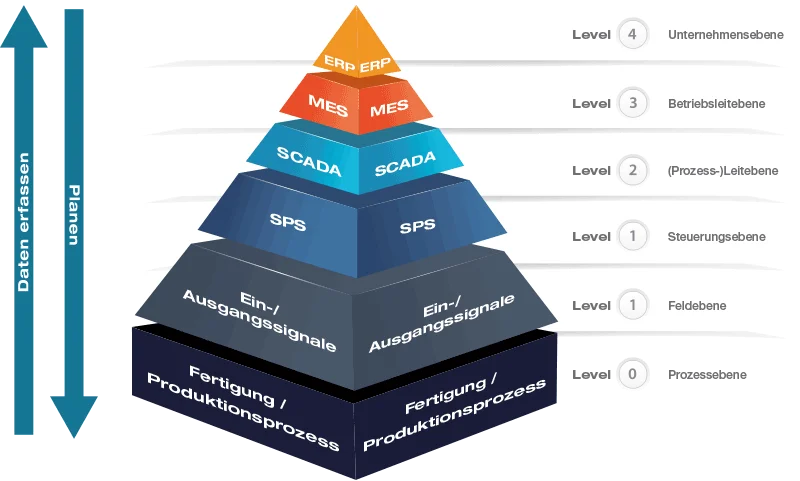
The model of the classic automation pyramid was created, which can also be used to easily illustrate the focus of a specific bus system based on its functionality.
 to top
 Contact
 Request form