






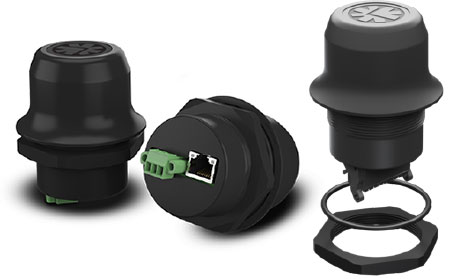
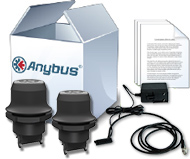
The Wireless Bolt enables you to connect machines to wireless networks. It is mounted on the control cabinet or attached directly to the machine.
Wireless transmission takes place via Bluetooth or WLAN. The wired connection within the machine or control cabinet is made via EtherNet. The Wireless Bolt is designed with IP67 protection and has a maximum range of 100 meters.
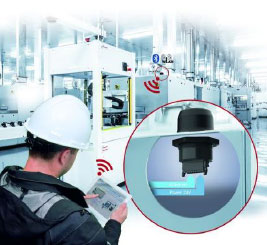
The compact Wireless Bolt brings wireless communication to (almost) any place in the machine or factory.
Mounted on a machine or control cabinet, the Wireless Bolt enables wireless access to machines via Bluetooth or WLAN.
BYOD
... use your laptop, cell phone or tablet instead of an HMI
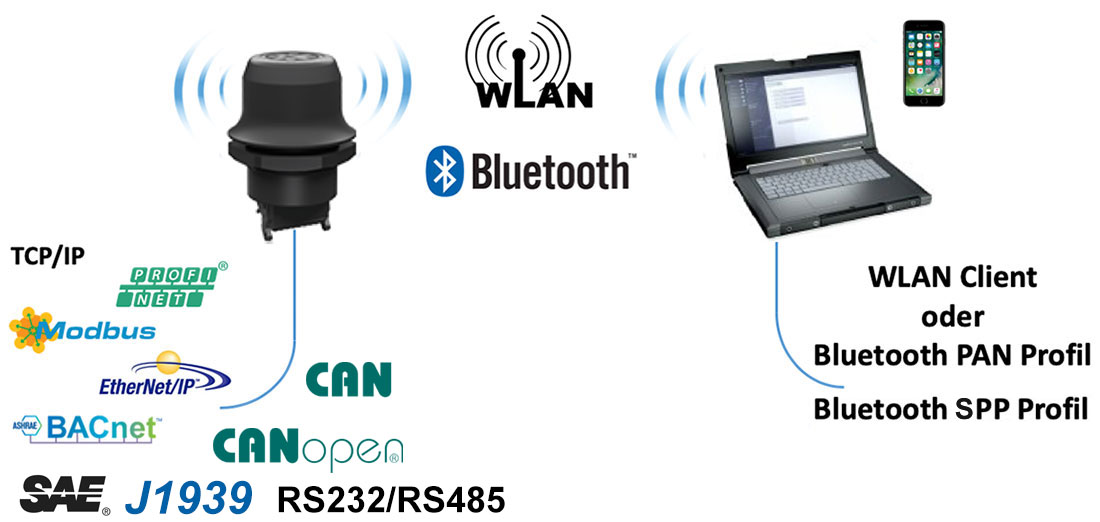
Connect a Wireless Bolt to your machine and access it via a laptop, tablet or smartphone.
BYOD (bring your own device) means that you no longer need an expensive HMI.
Multipoint or point-to-point
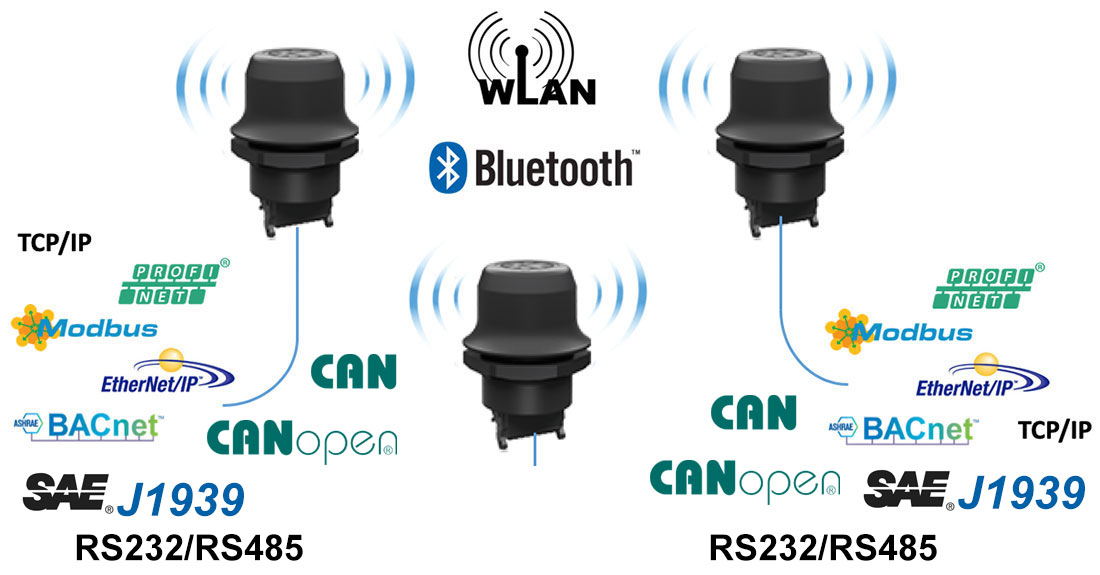
The Wireless Bolt is often used as an access point for several wireless LAN/Bluetooth nodes. However, it can also be used as a cable replacement (or instead of slip rings, drag chains, etc.) for EtherNet cabling (point-to-point communication or multipoint communication with up to 8 nodes).
Supported technologies:
WLAN
- Wireless standards: WLAN 802.11 a, b, g, n, d
- Operating mode: Access point or client
- WLAN channels: 2.4 GHz and 5 GHz
- Connection of up to 7 slaves when used as an access point
- Max. Net data throughput: 20 Mbit/s, Link speed: max. 65 Mbit/s (802.11n SISO)
- Security: WEP 64/128, WPA, WPA-PSK and WPA2, TKIP and AES/CCMP, LEAP, PEAP incl. MS-CHAP
Bluetooth
- Supported profiles: PANU & NAP
- Operating mode: Access point or client
- Max. Number of slaves when used as an access point: 7
- Energy consumption: 36 mA@24VDC
- Max. Net data throughput: ~1 Mbit/s
- Bluetooth version: Classic Bluetooth v2.1
- Security: Authentication & Authorization, Encryption & Data Protection, Privacy & Confidentiality, NIST Compliant, FIPS Approved
EtherNet
(WWBO2000/WWBO2001/WWBO2030/WWBO2031)
- 10/100 BASE-T with automatic MDI/MDIX cross-over
- Layer 2 bridging mode between Anybus wireless bolts or bridges, otherwise Layer 3 TCP/UDP bridging
- Supports the following EtherNet protocols: IP, TCP, UDP, HTTP, LLDP, ARP, DHCP Client/Server, DN
- Wireless bridging of the following Industrial Ethernet protocols: BACnet/IP, EtherNet/IP, Modbus TCP, PROFINET
CAN
(WWBO2020/WWBO2021)
- Conversion of CAN 2.0A/B (11/29-bit identifier) to wireless and TCP/IP communication
- Supports e.g. J1939 and CANopen as well as the transparent transmission of CAN protocols
- Cable replacement for CAN cables when using 2 bolts: "CAN to wireless to CAN"
- Baud rate range from 10 kbit/s up to 1000 kbit/s
- Up to 28 freely configurable CAN receive pass-through filters
RS232/RS485
(WWBO2010/WWBO2011)
- Converts serial RS232/RS485 communication into wireless and TCP/IP communication
- Cable replacement for serial cables: "serial to wireless to serial"
- Baud rate support 2400 to 921600 bit/s
- Special Modbus RTU mode
- Routing: Modbus TCP to Modbus RTU
 to top
 Contact
 Request form