


Industrial IoT (IIoT) brings together industrial machines, cloud computing, analytics and people to improve the performance and productivity of industrial processes. With IIoT, industrial companies can digitize processes, transform business models and improve performance and productivity while reducing loss. These asset-rich companies, operating in a range of industries including manufacturing, energy, agriculture, transportation and utilities, are working on IoT projects that connect billions of devices and deliver value in various use cases, including predictive quality and maintenance analytics, asset condition monitoring and process optimization.
A typical industrial plant has thousands of sensors that generate data. With IIoT, for example, manufacturers can combine machine data from a single production line, a factory or a network of sites, such as manufacturing plants, assembly facilities and refineries, to proactively improve performance by identifying potential bottlenecks, breakdowns, gaps in production processes and quality issues before they occur. Aggregating data from a network of sites can also lead to more efficient control of material flow, early detection, identification and elimination of production or supply bottlenecks, and optimized operation of machinery and equipment across all facilities.
Areas of application for industrial IoT
Predictive quality monitoring
Production quality is optimized through predictive quality analytics that extract actionable insights from industrial production equipment and environmental conditions as well as human observations. Higher customer satisfaction through high-quality products and reduction of recalls are enabled by predictive quality models with AWS IoT.
Monitoring of the plant status
With AWS IoT, the asset status of machines and devices can be monitored to determine asset performance. All IoT data can be collected, such as temperature, vibration or error codes, to see if all devices are working optimally. Plant utilization can be maximized to take full advantage of investments thanks to increased transparency.
Predictive maintenance
To identify potential failures before they affect production, the status of industrial equipment is recorded. The service life of equipment is extended and improved worker protection and supply chain optimization is possible. With AWS IoT, you can detect problems in real time by continuously monitoring the status, condition and performance of equipment.
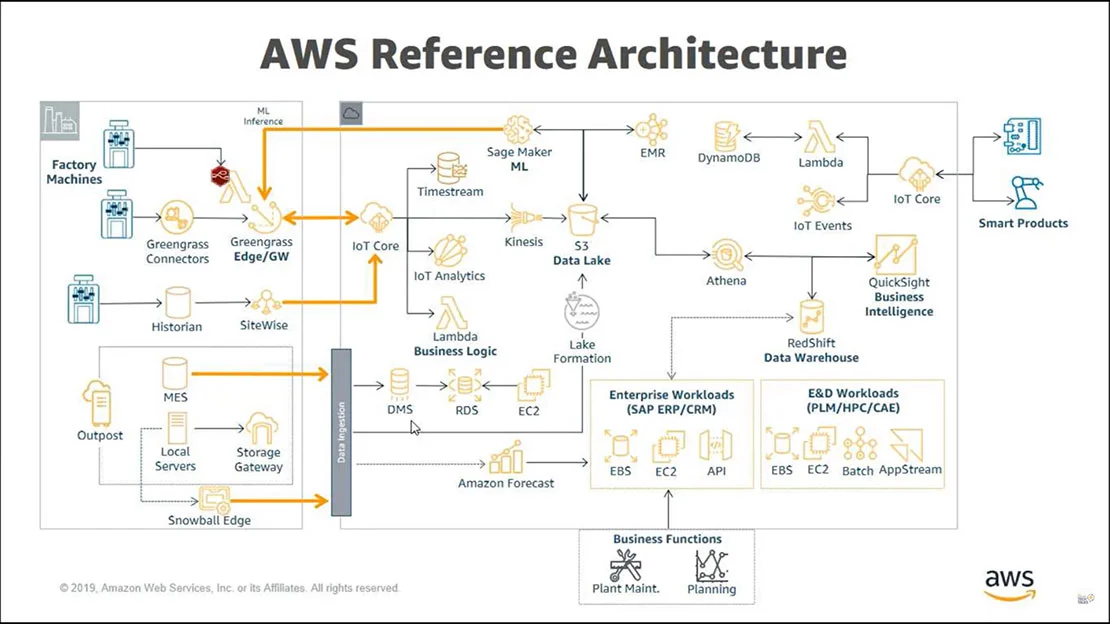
AWS IoT Greengrass is the edge component that has been optimized for data preprocessing to filter or edit data for IoT. It represents the connection between the edge and the cloud. Greengrass enables data processing and management, pre-built functions via edge applications, data transfer, installation and deployment functions, update functions, offline operation, integrated security functions and much more. Greengrass can be used on various hardware platforms (ARM or x86).
AWS Sitewise consists of an edge and a cloud component that can be used to manage industrial equipment via Sitewise in the cloud. Sitewise collects, organizes and manages data from industrial equipment. Real-time metrics can be generated to help customers make better data-driven decisions. For example, distributed sites can be monitored or local data can be processed. Various data sources can be connected, including proprietary databases. Asset models are created to monitor and visualize performance. Sensitive data can also be used purely locally, while others are transferred to the cloud. Sitewise enables the simple creation of web applications. The applications created can also be used locally or offline.
AWS IoT can process data directly via MQTT and the standardized Sparkplug B data format, which means it is possible to work with Unique Name Spaces at the edge, which then allows you to connect to UNS, IoT Core and IoT Sitewise at enterprise level.
The IoT Core is the backbone for the provision of the AWS IoT Cloud services. IoT Core handles connectivity and connection security. It is also where data is routed, processed and data-based actions are defined. Applications can also be provided for devices through interaction.
Lambda is a "Serverless Function as a Service" service. This means that it is not necessary to provide or manage servers that provide software functions. Usually, a corresponding physical or virtual hardware is required for the execution of software functions. With this concept, code can be written and loaded into the Lambda environment and used without having to provide the corresponding hardware. This concept is also very scalable, a pay-for-value model is common and the availability and fault tolerance are excellent. A wide variety of programming languages are supported. Lambda enables load balancing and management, automatic scaling, error handling, security isolation, operating system management, etc.
IoT Analytics manages services and analyzes data, and can also process large volumes of data. Data is filtered and enriched before it is stored in a database. The data can then be analysed and easily visualized. The data can also be further processed for machine learning.
S3 Data lake is a data repository of mostly raw data that can work with both structured and unstructured data from databases or various data sources. The data can be made available for a wide range of applications such as reporting, visualization, analysis or machine learning. AWS S3 is highly available, extremely performant, has unlimited storage and is very robust.
Quick Sight and Athena represent a possible visualization layer. Quicksight is a business intelligence application that provides quick insights into data from a wide range of sources. The data is presented in interactive dashboards with fast response times, making it easier to make better decisions. The dashboards can be accessed securely from any device. Hidden trends and insights can be easily discovered. Key business drivers can be identified. It is also possible to accurately predict future results.
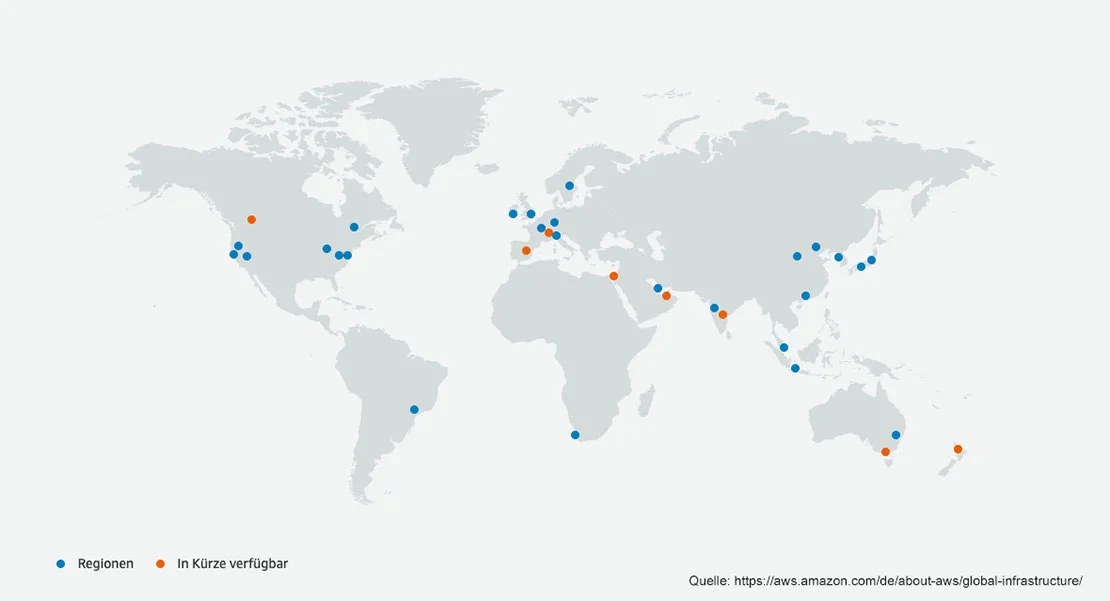
AWS already has over 1 million active customers in more than 190 countries around the world. There is a constant expansion of the global infrastructure to help customers achieve lower latency and higher throughput.
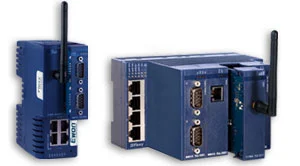
Remote maintenance
Modular remote maintenance and M2M router Ewon Flexy for remote maintenance and data services
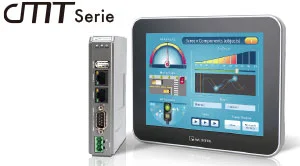
HMI and IIoT edge Gateways
The smart HMIs of the cMT series - Server / Client HMI architecture - High flexibility and strong improvement in work efficiency.
 to top
 Contact
 Request form