


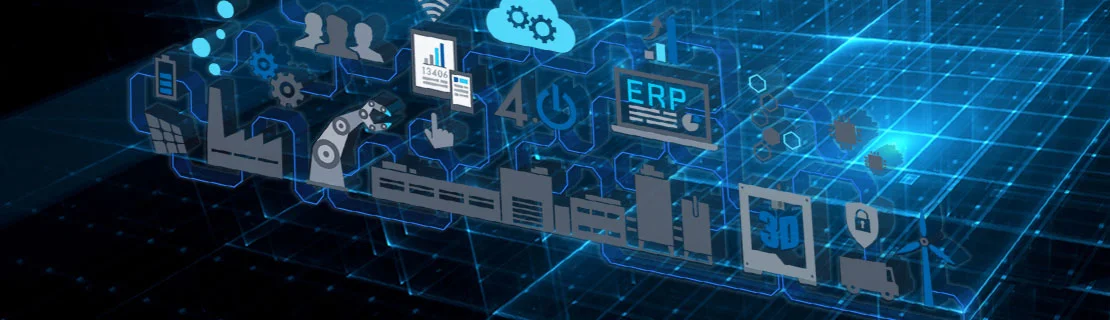








Industry 1.0:
At the end of the 18th century, a first step was taken in the form of the use of water and steam power (first mechanical loom in 1784).

Industry 2.0:
Electrical engineering and mass production emerged at the end of the 19th century (first assembly line in 1870).

Industry 3.0:
1969 Beginning of the use of automation technology and
programmablelogic controller(PLC) technology.

Introduction
Today, people are connected worldwide via social networks to exchange data. Digitalization and networking are also taking place in industry. Not only between people and machines, but also between machines and systems. The path must be taken from analogue centralized approaches to digital decentralized production processes. This requires active change management.
Industry 4.0 breaks with static, hierarchical structures, such as those depicted in the classic automation pyramid. Modern networking is dynamic and flexible.
At the vertical level, IT and OT systems are increasingly merging. The horizontal level networks companies with each other in order to realize an automated process along the entire value chain or even the complete product life cycle.
Lots of buzzwords - but what are the specific (customer) benefits?
We consider the following points, among others, to be very important:
- Making better decisions with more and more accurate information
- Efficient management of resources
- Increased productivity
- Saving energy
- Quality assurance
- Safety optimization at all levels
- Environmental protection
- More ergonomic working conditions
- Added value and new business models through data-driven services
The following developments promote Industry 4.0
- More cost-effective, networked sensor technology
- Faster processors and higher storage capacities
- Comprehensive networks for location-independent communication
- High bandwidths possible via the internet
Topics related to Industry 4.0:
Industrial Internet of Things / Internet of Things (IIoT)
IIoT is a term coined in the USA that covers parts of the overall approach of Industry 4.0. It is a variation of the Internet of Things (IoT) in the consumer sector. The Industrial Internet of Things is primarily concerned with the connectivity of devices/machines and people via the internet. An important goal is to make information available worldwide and at any time. Until now, people have in many cases been the interface between the real world of things and the digital world, but this is set to change with IIoT.
Digitalization / Digital transformation / Digital revolution
Increasing efficiency by converting analog data and files into digital formats. But it also includes digitizing analogue or manual procedures and processes. Digital transformation includes, for example, mapping functions in software instead of hardware.
Retrofit / plant modernization
In many cases, it makes sense to modernize a system or machine instead of replacing it, especially if just a few changes are enough to achieve set (production) goals or if maintenance/repairs and thus unplanned downtimes occur more frequently, which could be avoided by using a condition monitoring system, for example.
By updating the control technology, actuators and sensors as well as the communication interfaces, a machine/system can in many cases be made fit for Industry 4.0 and future-proof. Savings through retrofitting often include energy efficiency or reduced CO2 emissions. New legal requirements must also be taken into account.

There are various possible objectives in the context of Industry 4.0:
Asset management / plant asset management
Machine and asset management extends over the entire life cycle and is usually divided into phases.
 Development/ProcurementCommissioningdeployment planOngoing operationMaintenance workSpare parts managementReplacementdisposal
Qualified information that is available at all times is crucial for setting the right course.
Reducing the machine failure rate / OEE / condition monitoring
The continuous monitoring of machines and systems for their condition in order to be able to react quickly and efficiently in the event of a breakdown, but also the planned shutdown times due to maintenance work or changeover times, can be significantly optimized.
Overall EquipmentEffectiveness( OEE) is made up of performance, availability and quality and is calculated according to a defined standard. Corresponding key figures are required for this.
With the help of condition monitoring, for example, a system can be shut down for safety reasons in order to avoid major damage. This is done in three steps: Condition recording, comparison and diagnosis with subsequent measures. Many measures also help to maintain or even increase the value of the machine or system.
Machine optimization / smart factory / resource efficiency
Increasing the production rate, improving product quality, saving raw materials. A smart factory is characterized by a high degree of automation in production and logistics. It is flexible in the production of different products or even smaller series. Products can communicate with machines during the production process and it is possible to precisely track which production steps have been completed. Extensions to the use of the system enable the production of additional products and variants thanks to the corresponding flexibility.
Batch size 1
Series production takes a back seat, batch size 1 is not a costly custom-made product, as customer-specific adaptations can be produced very cost-effectively. Not only manufacturing processes, but also logistics processes must be optimized accordingly.
Predictive maintenance
Machine and system failures can quickly become very costly. Even planned shutdowns for maintenance purposes have so far often only been carried out on the basis of operating hours or quantities produced and not according to the actual degree of wear and tear of a component. By recording detailed system parameters over a longer period of time - ideally from several similar machines - data analyses can be used to gain insights into the wear and tear and changes to components and parts so that these can only be replaced when actually necessary.
New data-based business models and services:
Machine leasing
Although this has long been common practice in the consumer market, machine and plant manufacturers or financing partners also offer a form of machine and plant leasing. Terms, leasing rates and other framework conditions are usually defined.
This is interesting for the plant operator as they can always work with the latest machines, without any long-term capital commitment. Machine manufacturers can sell more machines and generate predictable, regular income.
Pay-per-use
A usage-based payment that - compared to leasing - offers the advantage of high cost transparency.
This makes it easier for system operators to calculate production costs. The key figures for usage are usually contractually agreed. In the simplest case, via an operating hours or quantity counter.

... as-a-Service
Provision of services, usually in the cloud. Neither a product nor a license is purchased, only the usage is charged.
Pay-per-outcome / performance-based contracting
Results-oriented business model in which the achievement of a specific target is contractually secured. This enables more reliable planning and a high level of cost certainty.
Guaranteed Availability
The aim of this business model is to guarantee the availability of products. The customer does not pay for the possession of the product itself, but for the failure-free use of the same.
This is particularly interesting in the case of machines whose failure can generate immense costs, e.g. by bringing the entire production to a standstill (downtime costs).
Ingredient branding
This business model uses the brand within the brand. It is used to market products or services that cannot be purchased separately but are an integral part of another product.
General: Increasing international competitiveness
Global pressure from competition is increasing and many machines are already highly optimized and very comparable. It is particularly important for Germany as an industrialized nation to exploit every competitive advantage. This can lie in innovative services as described above. There are no limits to creativity.
Various technologies are used to achieve the objectives
- Big data / smart data
Big data involves large volumes of data that cannot be processed or stored using conventional means. The amount of data and the data rate are constantly increasing, which means that the required systems must be highly scalable. The variety of data formats of structured and unstructured data is increasing.
Smart data refers to data that has already been pre-selected or pre-processed in order to achieve a higher quality. This saves bandwidth and storage space, e.g. in the cloud, during transmission via the internet.
- Cloud computing
This is a technology that is fast, cost-efficient and highly scalable, providing both storage and computing capacity on the internet. A distinction is made between- Public cloud
- Private cloud
- hybrid cloud
- Edge computing
In contrast to cloud computing, edge computing refers to decentralized data processing at the edge of the network, the so-called edge. Computer applications, data and services are relocated to the outer edges of a network in order to process data streams at least partially on site, e.g. directly on the end device or within a factory, in a way that conserves resources.
Edge computing is helpful if quick local intervention or control is required based on the data analyses.
The same applies if cloud connectivity is limited or not powerful enough or if personal data needs to be anonymized.
- Bring-your-own-device - BYOD
This involves increased ease of use through the use of end devices that the user is used to, e.g. smartphones, tablets, ...
- Cyber-physical systems
Hardware and software components that are networked with each other regardless of location.
- Virtual reality / augmented reality
Virtual reality is a great support, especially in the development of new machines and systems, but also for employee training.
Augmented reality supplements reality with additional information. This enables additional information to be displayed via data glasses or smartphones/tablets during commissioning, production and maintenance. Depending on the version, it is also possible to interact with the virtual world.
- Analytics
In order to improve and automate processes and make better business decisions, analytics deals with the acquisition, storage and processing of complex data volumes and data streams for anomaly detection and machine/deep learning.
- Machine/deep learning and artificial intelligence (AI)
Insights can be gained by uncovering patterns and regularities in collected data with the help of algorithms. Deep learning uses multi-layered neural networks.
With AI, machines take over decisions that were previously made by humans according to their programming. Information is collected and conclusions are drawn in order to interact with humans and machines. Continuous improvement, i.e. learning, is also part of the process.
- The digital twin
With an exact digital copy of the physical machine, various application scenarios can be easily simulated.
Our offer for Industry 4.0 and IIoT
service
We are happy to advise you right from the start of your Industry 4.0 or IIoT project. We can also provide you with advice and support during implementation as part of our services. Get in touch with us:
Products / Solutions
Data transmission in the industrial environment begins in the field, at the sensor/actuator level. Within a machine with the various fieldbuses and Industrial EtherNet as well as between the machines in a line or overall system. At the control level, data from lines and systems converge in SCADA, ERP and MRP systems. Data is exchanged across locations via the Internet and stored and analyzed in cloud platforms, for example.
Data-based services only work if data acquisition, data processing and transportation are guaranteed.
Remote maintenance
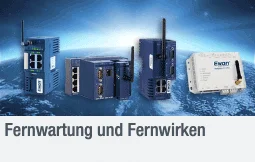
In addition to classic remote access to machines and systems via the Internet for troubleshooting, our remote maintenance routers offer intelligent services for collecting data from machines and systems that enable recording, alarming and visualization. With integrated programmability and data logging, data can be pre-processed before it is transferred to any application. Data can be transferred locally via OPC-UA or across locations via the Internet using MQTT, REST - or other interfaces, including to platforms of common cloud providers.
Industrial PC
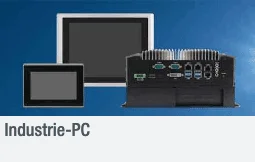
Reliable processing, storage and forwarding of locally generated data to the cloud using state-of-the-art, cross-interface transmission technologies requires highly robust yet powerful hardware. Our constantly growing range of IPCs includes devices for almost every condition and installation situation.
Whether panel PCs for machine operation and monitoring under the strictest hygiene regulations or box PCs for processing live image and video material, for example: the delay-free intervention in the running process made possible by EDGE computing or the reduction of data to be transferred to the cloud has become indispensable in today's Industry 4.0 requirements.
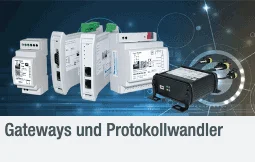
Gateways, protocol converters and repeaters
With the growing number of different interfaces and protocols, the implementation of standardized and proprietary interfaces and protocols is becoming increasingly important. Gateways are perfect for equipping old systems with new Ethernet-based interfaces. They also ensure compatibility with a wide range of PLC systems. Cloud Gateways create a data exchange option between industrial protocols and bus systems as well as cloud platform protocols such as MQTT, OPC-UA and REST.
Repeaters refresh signals in order to realize longer cable lengths or to enable baud rate adjustments between different participants.
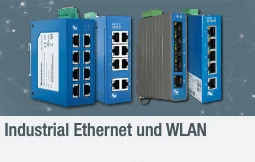
Industrial EtherNet components
The backbone of Industrial EtherNet networks is formed by Ethernet switches, which connect all participants with each other. Industrial switches meet the requirements of industry in terms of temperature ranges, power supply and service life. Gigabit and PoE technology has also arrived in industrial networks. With the help of fiber optic ports or media converters, long cable lengths can be implemented with very low susceptibility to interference.
Wireless technologies such as WLAN and Bluetooth are increasingly being used to reduce the amount of cabling required. Highly innovative solutions and great flexibility can be achieved through an intelligent combination.

Signal converter
The conversion of various digital and analog signals (such as voltage, current and temperature signals) enables the use of existing and/or new cost-effective sensors and actuators for connection to the control technology.
 to top
 Contact
 Request form